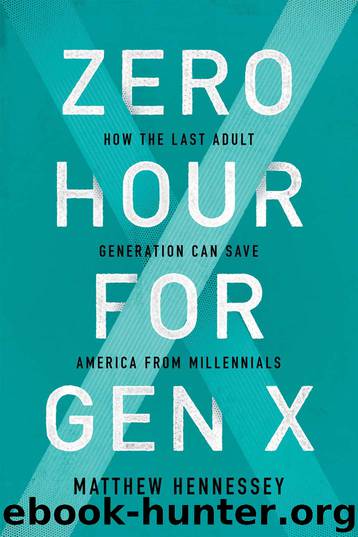
Zero Hour for Gen X by Matthew Hennessey
Author:Matthew Hennessey
Language: eng
Format: epub
ISBN: 9781594039959
Publisher: Encounter Books
Published: 2018-06-06T16:00:00+00:00
6About a year later I would get my cool card punched when I brought $15 down to Scotti’s and shelled out for cassette copies of the Smiths’ Strangeways Here We Come and the Pogues’ Rum, Sodomy, and the Lash, which, by the time I was through with it, could only be identified by the cover art on the tape box—the printed words on the side of the tape had been worn off by constant play.
SIX
Near Wild Heaven
During the mid-1990s, while Gen Xers were in their twenties, the Internet revolution was just kicking off. A quarter of a century later, that revolution is still in full swing. What it all means remains an open question. The Internet and its associated technologies are changing how we live in ways that no one fully understands (no matter how much they claim to). Everything is metamorphosing. From commerce to communication and from how we drive to how we think, the old ways are disappearing. Some of that change is for the good; some not. The one thing you can say about all of it is that it’s happening incredibly fast.
Uber-millennial Mark Zuckerberg dreamed up Facebook in his dorm room at Harvard University in 2004. In 2006, the social-media service began offering accounts to anyone aged 13 or older. In 2016, a mere 12 years after the site was conjured into being, Facebook announced that it had surpassed 1.65 billion monthly active users. In June 2017, they revised upward—2 billion.
As of May 2016, nearly half of Americans were getting their news from Facebook, even as traditional newsgathering organizations were folding up shop and laying off staff. In addition to its mysterious timeline algorithms, the company now employs a cadre of worker bees to “curate” the stories that appear on the site. In November 2016, Facebook announced that it would ban websites that peddle “fake news” from using its advertising platform. Facebook’s team of censors trawl the site day and night looking for content they deem hate speech, fake news, slurs, and calls to violence. In September 2017 it emerged that the site had sold hundreds of thousands of dollars’ worth of advertising to shady accounts originating in Russia who wallpapered the site with stories intended to influence the outcome of the Trump vs. Clinton contest. That same month Facebook admitted that it was cooperating with congressional investigators and a special counsel looking into potential foreign interference in the 2016 presidential election.
It goes without saying that Facebook has the right to police its property. You and I are under no obligation to use the site. But the fact is that most of us do, and with so many of us getting so much of our news from Facebook, there is another way of looking at its housekeeping efforts: a company that no one had ever heard of a decade and a half ago, and that is still run mostly by millennials—who at least one Silicon Valley entrepreneur describes as “scuzzy”—has granted itself extraordinary and unprecedented censorial power over the news we consume.
Download
This site does not store any files on its server. We only index and link to content provided by other sites. Please contact the content providers to delete copyright contents if any and email us, we'll remove relevant links or contents immediately.
| Anthropology | Archaeology |
| Philosophy | Politics & Government |
| Social Sciences | Sociology |
| Women's Studies |
Cecilia; Or, Memoirs of an Heiress — Volume 1 by Fanny Burney(32561)
The Great Music City by Andrea Baker(32021)
Cecilia; Or, Memoirs of an Heiress — Volume 2 by Fanny Burney(31958)
Cecilia; Or, Memoirs of an Heiress — Volume 3 by Fanny Burney(31944)
We're Going to Need More Wine by Gabrielle Union(19050)
All the Missing Girls by Megan Miranda(16038)
Pimp by Iceberg Slim(14515)
For the Love of Europe by Rick Steves(14149)
Bombshells: Glamour Girls of a Lifetime by Sullivan Steve(14078)
Talking to Strangers by Malcolm Gladwell(13375)
Norse Mythology by Gaiman Neil(13372)
Fifty Shades Freed by E L James(13245)
Mindhunter: Inside the FBI's Elite Serial Crime Unit by John E. Douglas & Mark Olshaker(9346)
Crazy Rich Asians by Kevin Kwan(9295)
The Lost Art of Listening by Michael P. Nichols(7507)
Enlightenment Now: The Case for Reason, Science, Humanism, and Progress by Steven Pinker(7315)
The Four Agreements by Don Miguel Ruiz(6767)
Bad Blood by John Carreyrou(6625)
Weapons of Math Destruction by Cathy O'Neil(6283)
